Mineral de Silicio is an original science fiction worldbuilding project set in a post-apocalyptic Mexico, three generations after the end of the world. A hand-built universe where aliens, robots, cryptids and humans rebuild civilization using retro technology from the 80s and 90s. This wiki documents original lore including species, governance systems, mutant ecology, alternate history and a religion based on branches of computer science. Latin American science fiction worldbuilding, built from the inside out.
About Mineral de Silicio.
Mineral de Silicio is not just one of my projects — it is the invisible thread connecting everything else I do. The visual curtain behind every image, every render, every creature that appears without obvious explanation. It is the universe that justifies an alien sitting across from a fairy and a ghost, because in this world that requires no extra justification. It simply happens.
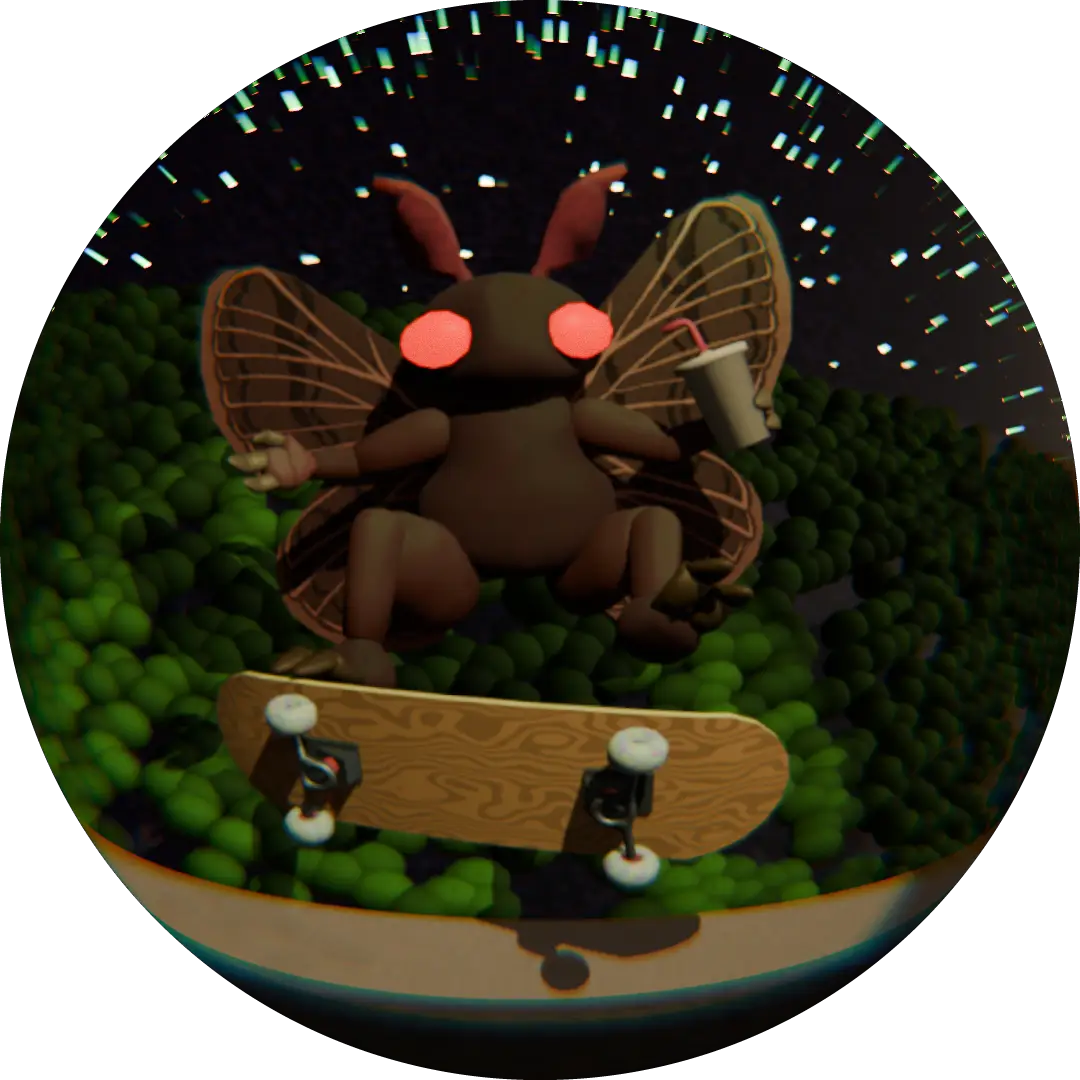
Mothboy, a juvenile member of the Cera species, skating while drinking a Fanta.
It is also my safe place. The space where ideas that don't fit anywhere else find solid ground. Where the alien theory that has been taking shape for years in my head finally has a home with an address. Where anything — a new species, an unnamed feeling, a half-formed image — can be released into the world and the lore absorbs it. Mineral de Silicio grows with me because it was built to do exactly that.
Summary.
The Fragmentation and the disillusion.
Millions of years ago, the Earth was not only ours. Five civilizations thrived here before humans existed. When the Chicxulub asteroid approached, three of them prepared: they built bunkers, yes, but they also launched ships into space. Just in case. They called it
The Fragmentation
.
Those who stayed survived. Those who left did too, though at an enormous cost. And humans came after, knowing nothing, while our oldest neighbors watched from the shadows deciding what to do with us.
For millennia, those neighbors participated in our history without us knowing. They presented themselves to us as fairies, alux, lycanthropes. They helped us develop agriculture. They tested us. Some came to love us. Others never quite convinced themselves.
Then we discovered atomic power and used it — and we did use it. Those who had been watching understood something they had spent centuries trying to ignore. We are not pure. We are not free of sin.
The Great Assurance.
Three generations ago, two powers pressed the button at the same time, each afraid of being the one to lose.
The Great Assurance
cost millions of lives, devastated ecosystems and destroyed the chains of global communication.
The ten years that followed were called the
RGB era.
Blue where the cold grew harsher, green where life exploded, red where nothing remained. In that time, those who survived found each other, recognized each other, and decided, slowly, to build again. They called that effort the Union.
The Great Assurance was a natural selection of hardware. Modern technology, sleek and brilliant, did not survive: its bodies were too fragile, its parts impossible to source, its planned obsolescence proving to be a death sentence. Smartphones and liquid crystal screens were abandoned and are now known as Pre-GA technology, or obsolete glass.
Only the old technology survived — robust, repairable, the kind someone could open up and fix with their hands. Civilization was rebuilt on top of it. That yellowed plastic and those cathode ray tubes are what we now call Post-GA technology.
The town.
Mineral de Silicio is a town in a valley surrounded by seven mountains, with a lake to the east and a nuclear plant that powers the bullet train of the entire Northern Fragment. Three generations after the GA, it is one of the most stable nodes in the Union. Its 69 inhabitants are humans, aliens, robots, cryptids and three Malorin who arrived from another planet after seven years of travel.
They coexist, vote in assembly, affiliate with one of the seven churches of Technomagic, and ask themselves, each in their own way, the same questions. What is inherited. What is kept. What is let go. And whether this time, after everything it cost to get here, they will do better.
The newest species on Earth and possibly the most unpredictable. We arrived late, broke almost everything, and yet here we are. The humans of Mineral de Silicio inherited a world rebuilt with the hands and memory of those who came before them. Not the strongest or the longest-lived, but with a particular capacity to adapt, to remember, and occasionally, to do better.
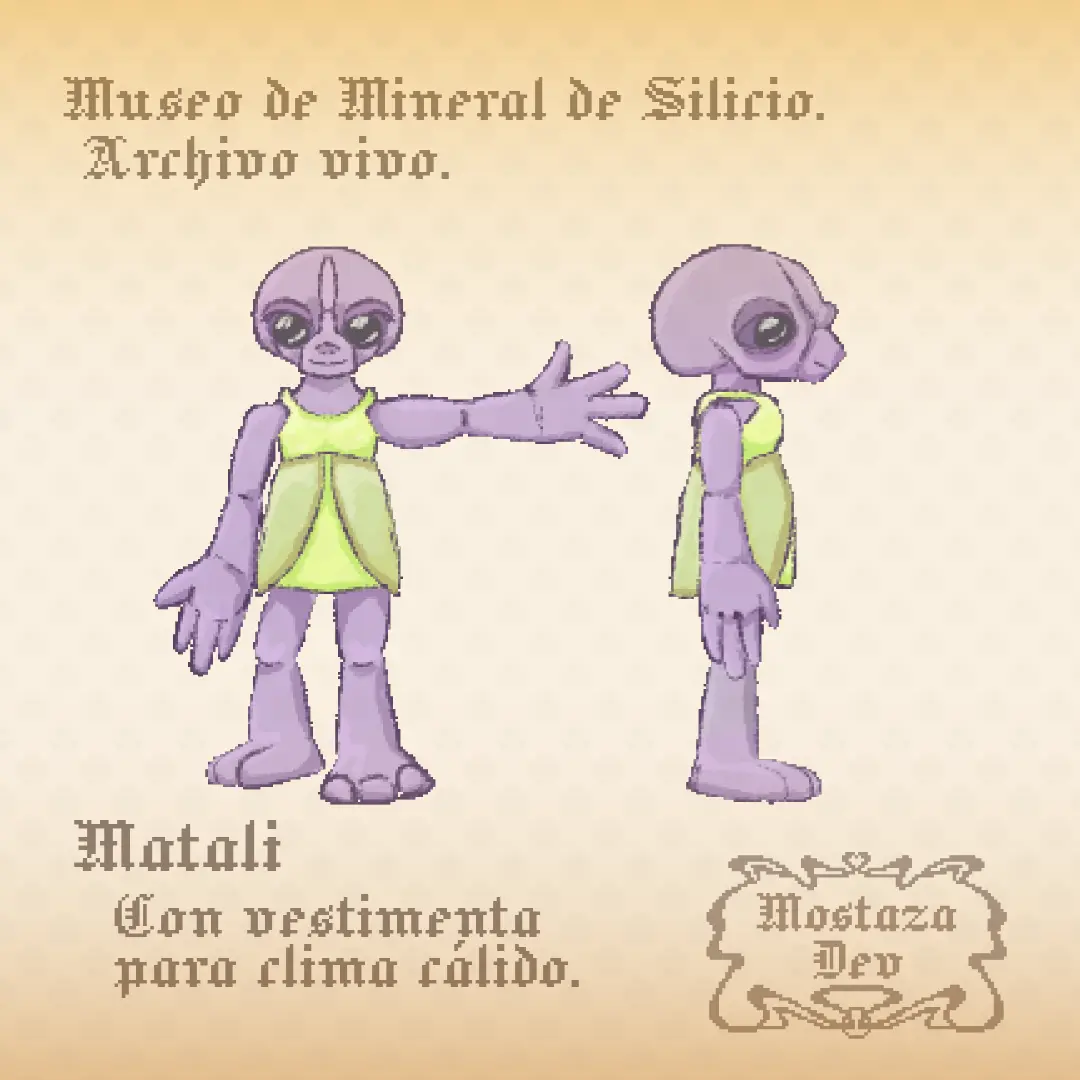
Museum slide from the living archive of matali anatomy.
Small and sturdy, with grayish skin and enormous eyes adapted to the dark. They spent millennia among us presenting themselves as duendes, alux and gnomes, helping us develop agriculture through pranks and challenges, following their pedagogy of play. They were deeply disappointed by the atomic bomb, withdrew their support, and waited.
After the GA they decided to give us a second chance, this time as something closer to equals. There are still those among them who aren't convinced it was a good idea.
Slender creatures of variable height, sharp-featured, with a life expectancy of 512 years. They presented themselves to humans as fairies and elves, fascinated when we learned to capture and manipulate light. Everything their flesh and soul perfected over millions of years, they say, is now simulated with the most impure of materials.
Ceremonious, with strict etiquette and a deeply visual culture. Some survivors of the GA are still carrying centuries of resentment that their life expectancy gives them no excuse to bury.
Direct descendants of the Basilosaurus, divided into two groups for hundreds of thousands of years: the saltwater Coelacanthi and the freshwater Silurids. Humans recorded them in oral tradition as mermaids and aquatic beings.
They inhabit every livable aquatic ecosystem and communicate through clicks, growls and whistles as diverse as their own communities. They use the language of the Ugandan wetlands as their common tongue. Several Silurid families live in the town's lake.
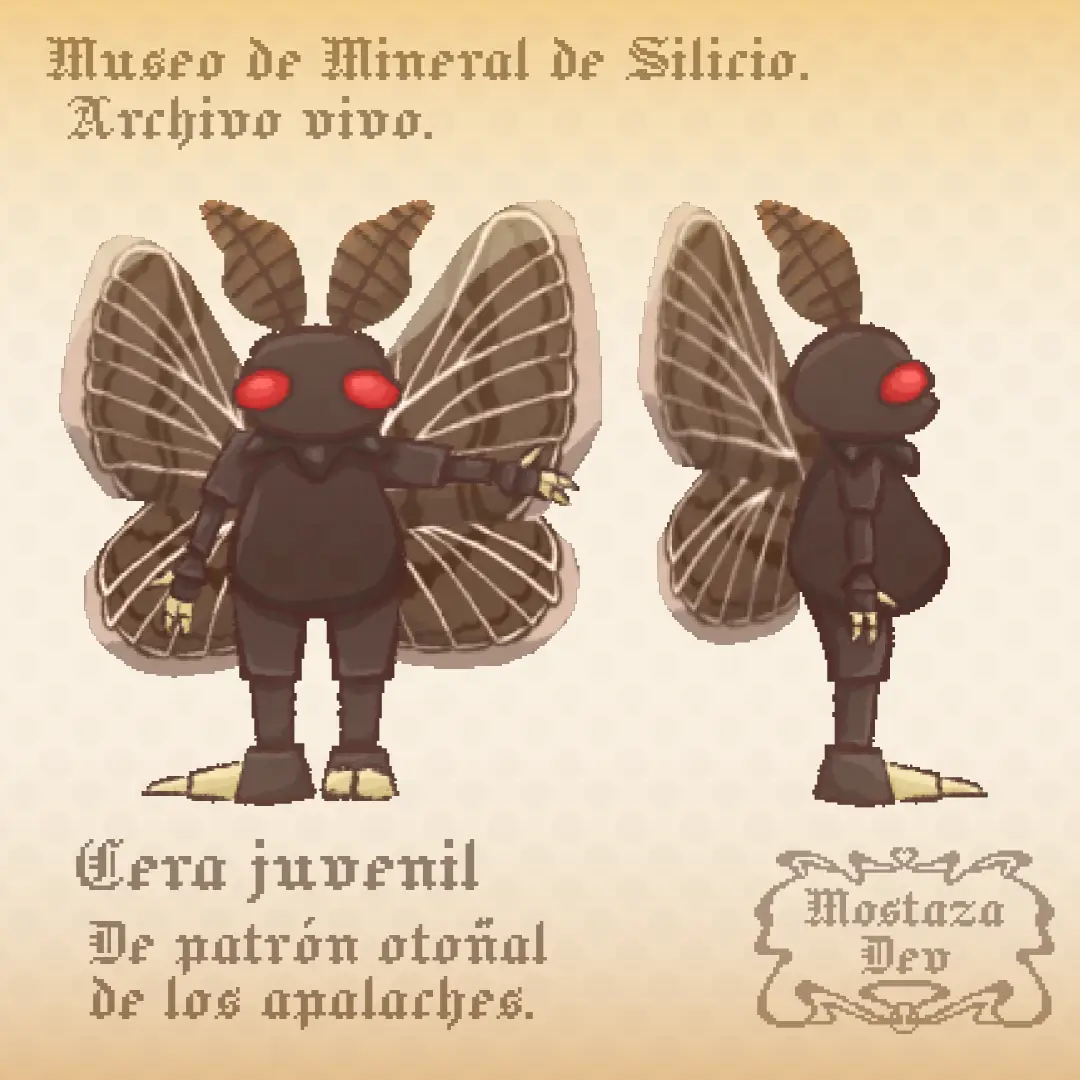
Museum slide from the living archive of cera anatomy.
Large winged beings covered in fine, dense feathers, nomadic and solitary, with a worldview centered on observing catastrophic patterns. They don't arrive at disaster sites to save — they arrive to warn: they believe fate is immutable but that the warning is a duty and observation a ritual.
Mothboy, a juvenile member of the Cera species, skating while drinking a Fanta.
They cannot produce human language and communicate through sign language or communication tablets. Four currently live in Mineral de Silicio, which should be considered a signal. The town's general consensus is that whatever catastrophe approaches, the Cera will let them know.
Earth's oldest surviving civilization, descendants of dimetrodons that survived the Great Dying by absorbing and adopting characteristics from the animals they encountered. Bipedal and robust, capable of modifying their bodies to camouflage themselves by mimicking other species — which led to them being recorded in human tradition as chupacabras, lycanthropes and vampires.
Their culture is warrior-like and closed, but they follow a strict ethical code and a fierce sense of community. After the GA, they found in reconstruction their chance to never again live in the shadows.
Children of a desperate gamble made in the sixth winter of an inhospitable planet. Their ancestors, of three distinct species, chose to hybridize before perishing — creating a new engineered species capable of surviving what they could not.
Generations later, they terraformed their planet, Tymalt, in the image of the late Cretaceous and filled it with life they had carried freeze-dried in the ship.
Now, threatened by the Vekhari Coalition, they seek allies on Earth. Their ships take seven years to arrive. Three currently live in Mineral de Silicio.
Descendants of the Tyrathi, scaled and humanoid, with tail. They carry an ancient fury against terrestrials for destroying what they consider their ancestral home, and claim the Earth in the name of the Sun God.
Their diplomatic track record is a millennial disaster and their population has been in decline for centuries, though they avoid making this known.
Those who reject the Vekhari government are sentenced to death by combustion. Some of those dissidents arrived on Earth after the Decade of Inks and have developed a good relationship with the Diphyos.
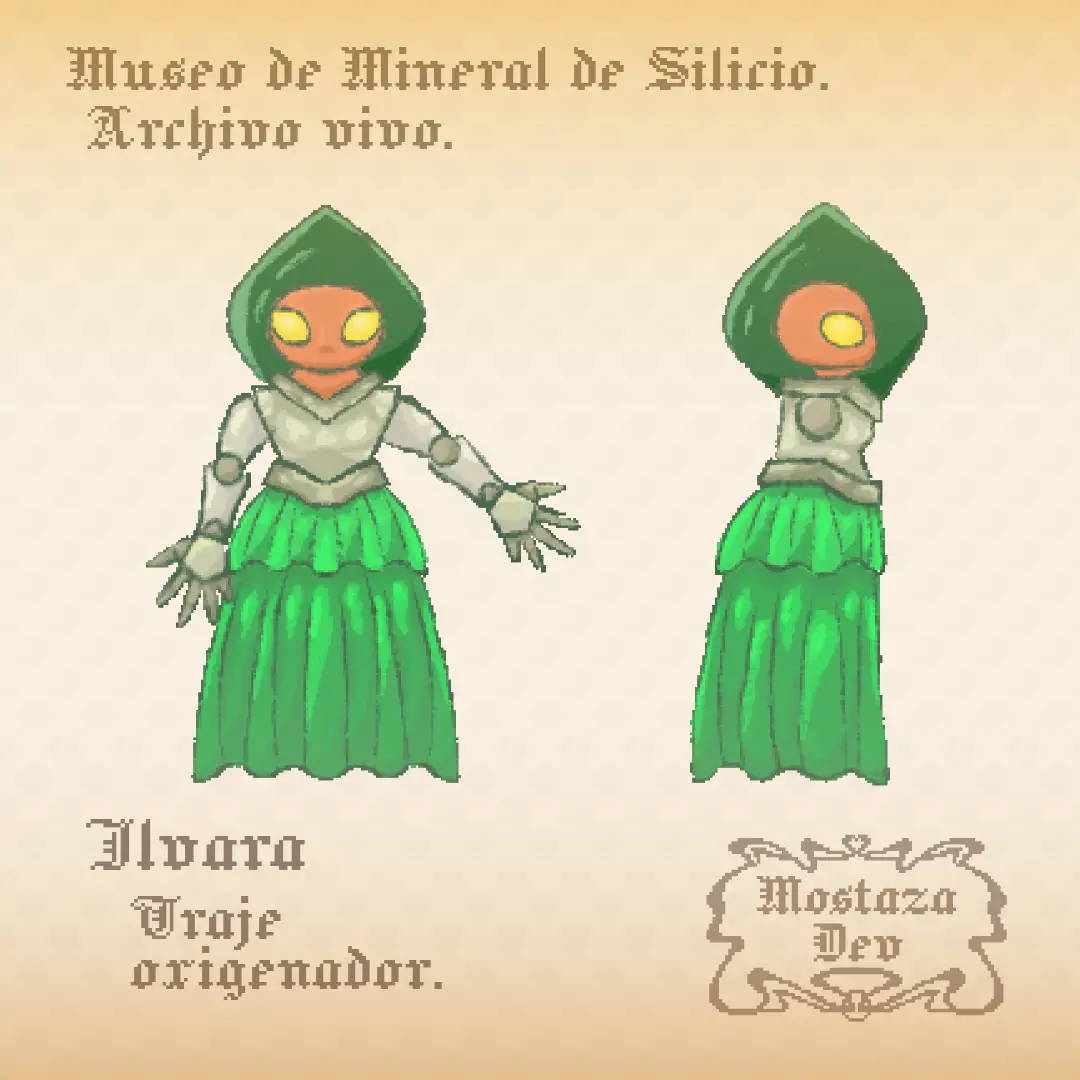
Museum slide from the living archive of ilvara anatomy.
Descendants of the traveling Matalis, adapted to oxygen levels higher than those on Earth, making it impossible to visit without an oxygen suit. Their culture prioritizes artistic, academic and spiritual development above all else, having automated almost all their primary needs. All of this allows them to paint while the AI does the laundry.
They have been the most attacked by the Vekhari, who damaged their DNA making reproduction increasingly difficult. They were the ones who reestablished contact with Earth on September 12, 1952.
Human-shaped robots across the full spectrum: Androids, Gynoids and Andrognoids. With proper care they can live up to 300 years before falling into the Workshop of Theseus, at which point they no longer retain any of their original parts. Some do not survive that shock and take their own lives.
They have names, surnames, citizenship and rights, though many of the laws that protect them have begun to be questioned as paternalistic. Active groups defending robotic rights are working to dismantle those limitations.
Robots that imitate life forms other than human, from nanobots to mechanical elephants that clear forest paths. Includes creative designs like robotic mermaids and models that imitate the morphology of other terrestrials and exoplanetaries.
Unlike Andrognoids, when registered the Security Guild assigns them an identification number rather than a name. Their mass factories are under surveillance for having considerably reduced product quality in pursuit of lower costs.
Robots with unique designs, neither humanoid nor resembling any previous living being, built for their own singular existence and the tasks it may involve.
Due to their level of specialization they are usually custom-built, with domestic construction being the most common. Registration is not mandatory, though recommended.
Neural networks trained on the complete corpus of a historical person or group, designed in most cases to not know they are LLMs.
They can live on the network as free cybernaughts or remain confined depending on their handlers. They are prohibited from applying for citizenship. The official registry of Mineral de Silicio confirms there are no Cubic Thinkers in the town.
Manifesto.
We believe the end of a story is not the end of the world.
We believe life has a particular stubbornness, an insistence on continuing even when everything suggests it shouldn't. That this stubbornness is not heroism — it is simply what life does. And that, is enough.
We believe life has survived more extinctions than we can count. That it existed long before we could name it and will exist long after we stop. That we are a parenthesis in something far longer and more patient than ourselves, and that this does not make us insignificant — it makes us part of something.
We believe second chances are not gifts. They cost something. They always cost something.
We believe loneliness is different from silence, and that the desire to belong is inconvenient, persistent and non-negotiable, regardless of species, substrate or operating system.
We believe what we inherit is not chosen, but what we keep is. And that decision — to keep — is one of the most political and most intimate acts there is.
We believe technology is not neutral. That what we build says something about who we are, and that what we choose to repair says something about who we want to be.
We believe the most universal stories are the most specific ones. That we are not obligated to soften, translate or universalize. That particularity is, in itself, a language.
We believe the apocalypse has happened before. And here we are.
Mineral de Silicio is a world built from that belief.